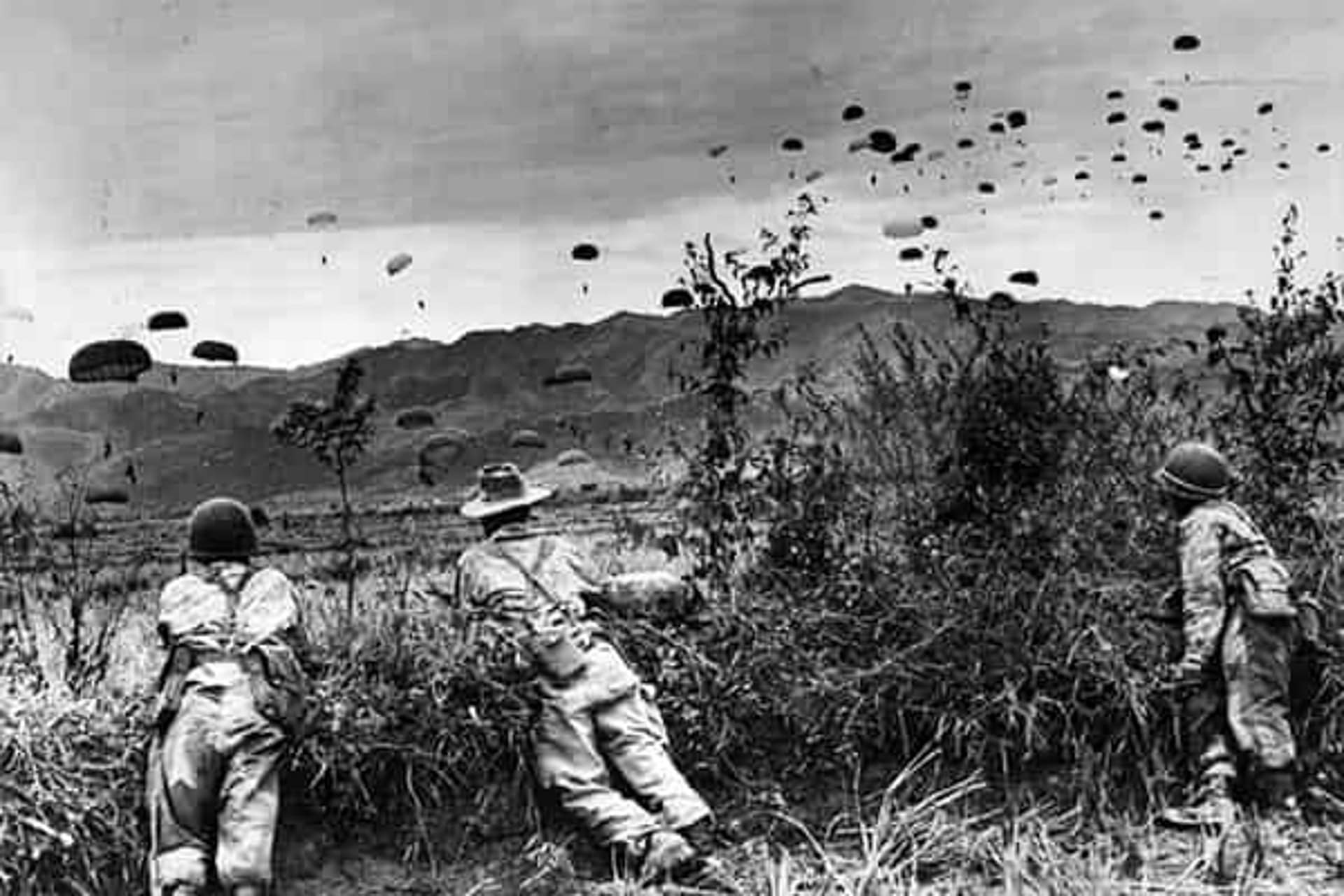
Operation HIRONDELLE, 17 July 1953. The French High Command in Indo-China, acting on time-sensitive intelligence, deployed 2000 paratroopers more than 100km behind enemy lines, destroyed a major Viet Minh logistic hub, then deployed another parachute battalion, a mechanised brigade, and a Naval task force to get them out again. All in the space of 72 hours. The operation did not change the course of the war, but demonstrated the decisivenes and agility of the French Far East Expeditionary Corps
This Reading Room selection brings together the most accurate, insightful, and strategically valuable books on the French Indochina War (1946–1954). Every title has been hand-curated based on its use of primary sources, operational clarity, and relevance to understanding the decisions, terrain, command dynamics, and campaigns of the conflict.
This is not an exhaustive bibliography — it is a best-in-class recommended reading list designed for serious readers, battlefield historians, and anyone seeking a deeper understanding of the Franco-Viet Minh war.
French Indochina War – Operation Castor, the seizure of Dien Bien Phu, 20 November 1953.
Understanding a complex decolonisation conflict through its historians and primary sources
The French Indochina War (1946–1954) has generated a rich and evolving body of literature, shaped by the perspectives of French officers, Viet Minh veterans, foreign observers, and modern scholars of insurgency and counterinsurgency. Unlike many mid-20th-century conflicts, the available sources span official reports, campaign journals, personal memoirs, and later analytical studies — each contributing to a deeper understanding of the strategic dilemmas, operational choices, and terrain-driven realities of the war.
Much of the early English-language reading on the conflict drew upon French officer memoirs and operational studies. Classics such as Bernard Fall’s Street Without Joy and Hell in a Very Small Place remain indispensable for their combination of tactical detail, political insight, and fieldwork-based observation. Fall’s ability to integrate interviews, battlefield exploration, and archival research made him the foundational Western historian of the war. French officers such as General Võ Nguyên Giáp (for the Viet Minh side), Paul Galula, and Roger Trinquier contribute additional layers of interpretation — from revolutionary warfare to counterinsurgency theory — helping readers understand how doctrine evolved in response to battlefield experience.
Modern scholarship has broadened the lens. Historians such as Martin Windrow, Henri Navarre, Pierre Journoud, Christopher Goscha, and Fredrik Logevall situate the war within the wider dynamics of nationalism, decolonisation, and Cold War geopolitics. Their work illuminates the tensions within the French high command, the political and logistical constraints shaping CEFEO operations, and the Viet Minh’s development into a capable and adaptive field army. Studies of the northern campaigns — particularly Route Coloniale 4, and the continuous fighting along the mountainous Sino-Vietnamese frontier — reveal how terrain, mobility, command culture and intelligence shaped outcomes long before the climactic battle at Điện Biên Phủ.
For the battlefield historian or serious reader, these books offer multiple avenues into the conflict: operational analysis, strategic debate, political context, personal testimony, and the lived experience of fighting in the jungles, highlands and river valleys of Indochina. The titles gathered here provide curated entry points into that literature, supporting deeper study of campaigns such as Phu Tong Hoa where the Viet Minh learned combined arms tactics, theRC4 disaster of 1950, the de Lattre counter-offensives, bold counterstrokes like Operation HIRONDELLE, and the final set-piece at Điện Biên Phủ.
Whether approaching the war from the perspective of military history, counterinsurgency, decolonisation, or battlefield terrain analysis, these works form the essential foundation for understanding how France lost Indochina — and how the Viet Minh learned to win.
The Amazon links on the Reading Room pages are powered by AAWP
Reading
The reference collection below includes the key books and references I have used in preparing for and undertaking French Indochina War battlefield studies.
Street Without Joy has long been the standard text for the Indochina War. Fall covers the long painful road to Dien Bien Phu and beyond, including the destruction of Groupe Mobile 100. For many of the battles, Fall is the only author to have covered them.
Giap’s memoir is amust read for any student of the Indochina War. Although the language can be stilted and ‘propagandistic’ in the old communist style, it is still the definitive account of the Viet Minh side of the war.
Raoul Salan’s Volume 2 of his ‘Memoires’ is the definitive military-political coverage of the Indochina War. Salan would later lead the revolt in Algeria against De Gaulle’s government, and he would go on to lead the OAS.
An incredibly detailed study into the formed and ad hoc Legion units that served in Indochina and the equipment they used. An absolute must for students of the Legion and the Indochina War. Several descendants of Legionnaires have approached me in researching their fathers/grandfathers, and this is my first point of reference in helping them.
Best works on the Battle of Route Coloniale No. 4 (French)
In French. Colonel Pierre Charton led the column from Cao Bang to link up with Lepage around Dong Khe. His column was destroyed in the jungled hills around Hill 477 and Coc Xa and Charton spent four years ina Viet Minh POW camp. Absolutely essential reading for students of the RC4 campaign.
In French. Colonel Marcel LePage led Group Bayard from Lang Son to Dong Khe to help extract Charton’s column from Cao Bang. The LePage column was destroyed in a series of battles around Dong Khe, Coc Xa, Hill 477 and That Khe. LePage spent four years ina Viet Minh POW camp. Absolutely essential reading for students of the RC4 campaign.
For decades, Bernard Fall’s “hell in a Very Small Place’ was the definitive account of the Battle for Dien Bien Phu. . Fall had access to the survivors and produced a harrowing account. Fall was killed near Hue city in 1967 while working with a US Marine unit as a journalist.
Martin Windrow has been a prolific author on the French colonial campaigns and his ‘Last Valley’ overtook Bernard Fall’s ‘Hell in a Very Small Place’ as the definitive account of the battle. Windrow had access to more records and archives, and has more space to tell the story of the lead up to the battle and the battle itself. A tour-de-force!
Jules Roy’s book was my first book on Dien Bien Phu. It remains one of the best accounts, although since overtaken by authors like Windrow as access to archives and records have opened.
Valley of the Shadow has gained a reputation of setting a new standard for coverage of the Battle for Dien Bien Phu. Even Martin Windrow said it was the most comprehensive account yet; high praise indeed!
The legendary story of Bigeard’s 6th Colonial Paras at Tu Le (French)
In French. I walked the ground at Tu Le in 2025, and followed the epic retreat of Bigeard and the 6th Colonial Paras in the face of a pursuing Viet Minh force 10x their size. One of the epic military stories of the 20th century.
Firsthand account by a French colonial paratrooper, Hoa Binh offensive
One of the best firsthand accounts of the French Indochina War. Written by a paratrooper in the 7th Colonial Parachute Battalion. Covers the endless grind of counter-guerilla warfare, and dedicates several chapters the Hoa Binh operation of 1951-52.
Authored by Mick Prictor, a retired military officer with 40 years’ service, and a military historian specialising in terrain-focused analysis of tactics, doctrine, and command decision-making in land warfare. His work draws on extensive battlefield fieldwork—more than 280 sites worldwide—and one of the world’s largest private collections of historic military arms, uniforms, and equipment. About me
What are the best introductory books on the French Indochina War?
Bernard Fall’s Street Without Joy and Hell in a Very Small Place remain the most accessible introductions, blending operational detail with on-the-ground reporting. For a broader strategic overview, Fredrik Logevall’s Embers of War is an excellent starting point.
Which modern historians offer the most authoritative analysis?
Martin Windrow, Christopher Goscha and Pierre Journoud are among the most influential contemporary scholars. Their work integrates Vietnamese, French and international sources, providing a balanced understanding of both the political and military dimensions of the war.
Are French officer memoirs still useful for studying the conflict?
es. Memoirs by officers such as Roger Trinquier, Paul Galula and Henri Navarre provide invaluable insights into French doctrine, counterinsurgency thinking and the operational challenges faced by CEFEO forces. While subjective, they remain essential primary perspectives.
How reliable are Viet Minh sources for understanding the war?
Viet Minh accounts vary in detail and transparency, but they offer crucial insights into organisation, logistics and political strategy. When combined with French archives, U.S. intelligence reporting and modern Vietnamese scholarship, they significantly enhance historical understanding.
What themes do historians debate most about the war?
Key debates include the effectiveness of French command and control, the impact of terrain on operations along the RC4 corridor, the evolution of Viet Minh strategy, and the extent to which the conflict foreshadowed later U.S. involvement in Vietnam.
Why is Bernard Fall considered so important to the study of the war?
Fall combined archival research with extensive fieldwork, interviews and first-hand observation of active combat zones. His ability to connect terrain, politics and military decision-making set a standard that has shaped scholarship ever since.
Subscribe to Battlefield Travels and receive a free E-Book Battlefield Guide
Unlock expert battlefield analysis, campaign reconstructions, and historical insights drawn from firsthand exploration and primary sources.
🗺️ You’ll receive:
🎖️ Exclusive historical insights you won’t find elsewhere
📘 A free eBook: 10 Tips for Exploring Historic Battlefields
📰 New battlefield studies straight to your inbox as they are published
Claim Your Free Battlefield Travel Guide
Get your free e-book, exclusive tips, and updates on new battlefield studies.
Thank you!
You have successfully joined our subscriber list.
⚔️ Go deeper — Members get exclusive access to the Deep Research Collection, Field Notes, and monthly Research Dispatches. Try membership free for 7 days, cancel anytime. From $9/month.